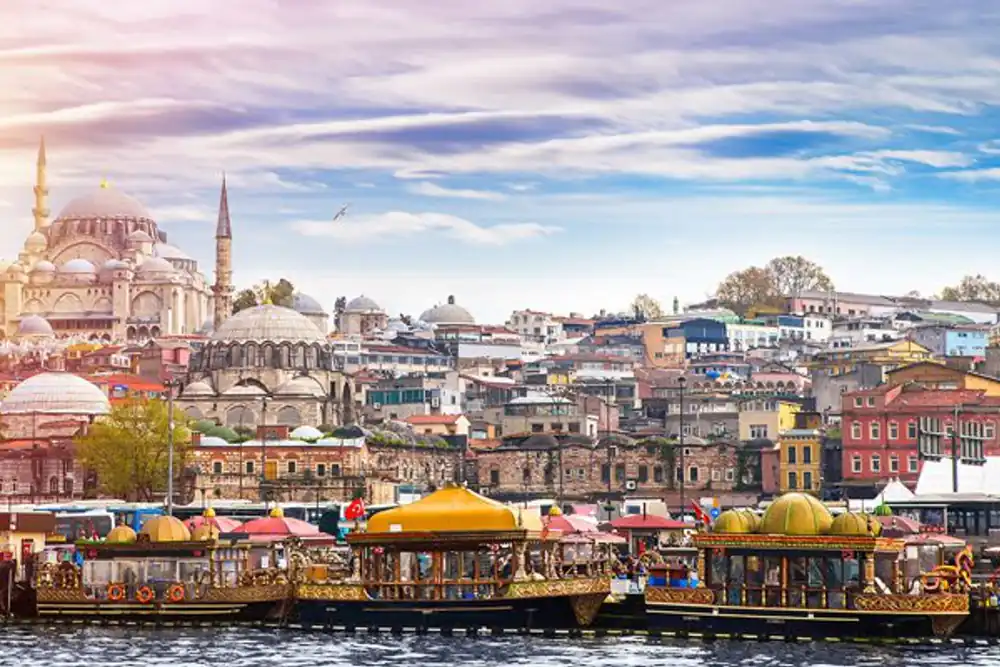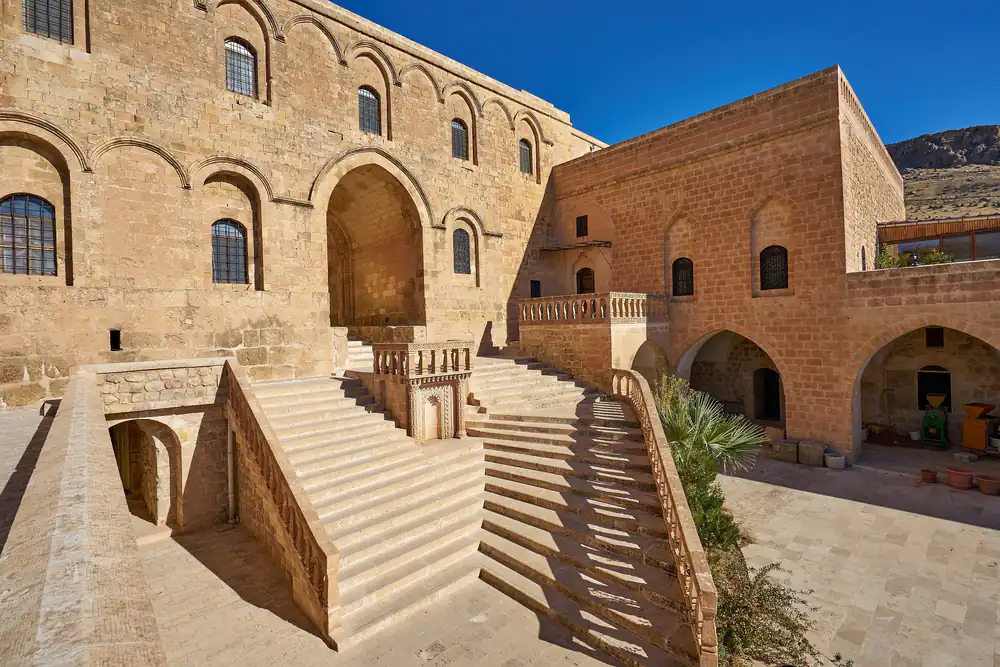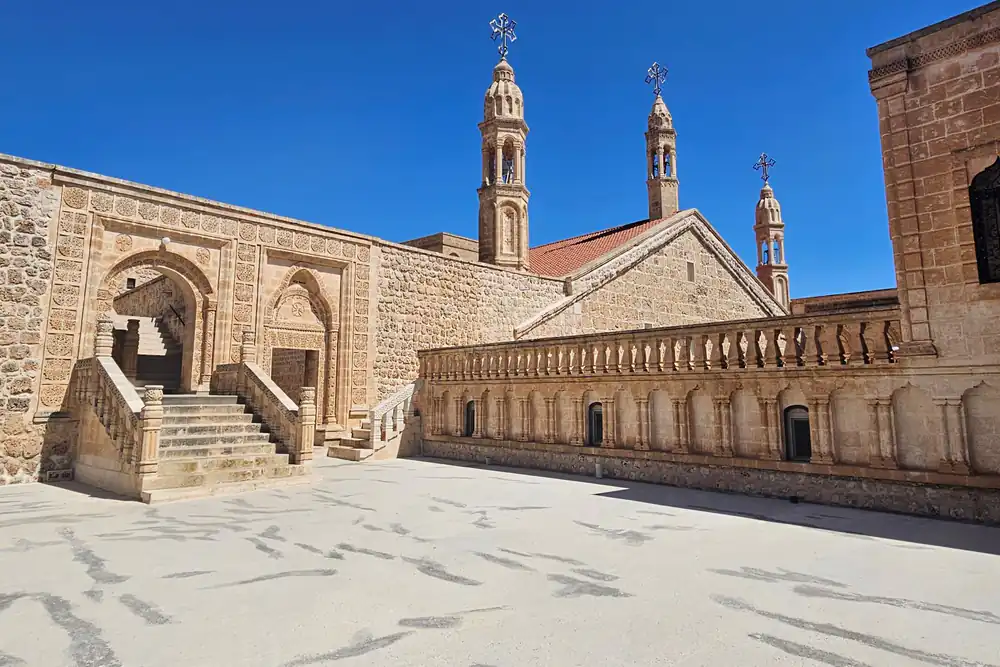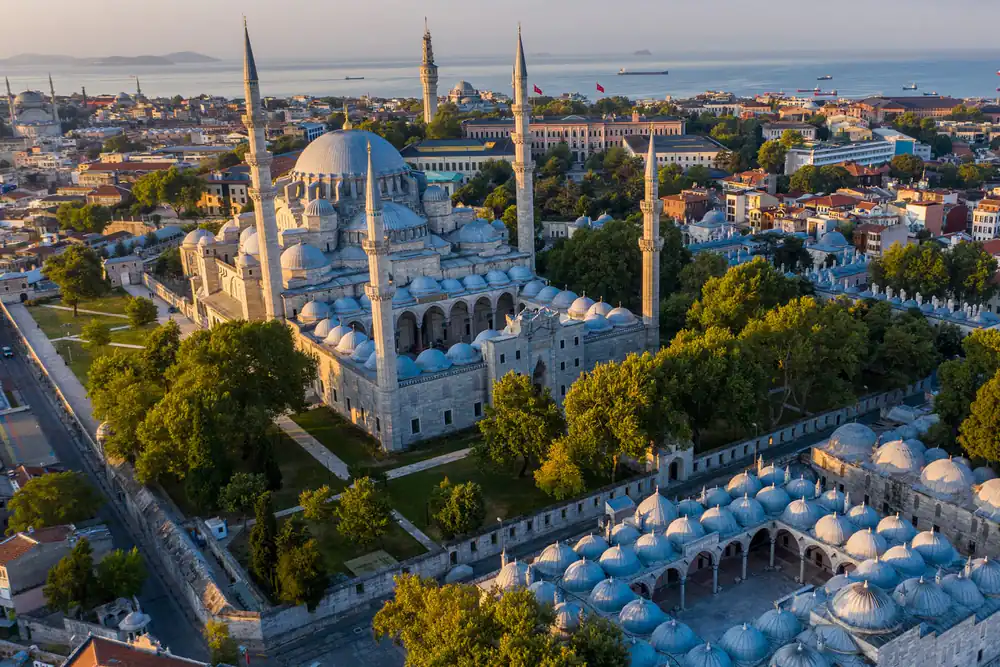
At Süleymaniye, look beyond the dome. The courtyard, skyline, neighbouring streets and buildings of the wider complex explain why an Ottoman imperial mosque was also part of the life of a city. This guide focuses on what to notice in Sinan’s architecture and how to understand the site without reducing it to a list of measurements.
For dress, access planning and a short neighbourhood route, use our separate Süleymaniye visitor guide.
Sinan’s mosque in its historic setting
UNESCO dates Sinan’s Süleymaniye Mosque complex to 1550–1557 and recognises it within the Historic Areas of Istanbul. Commissioned during Sultan Süleyman’s reign, the building is a key place to understand sixteenth-century Ottoman architecture.
Its setting matters. GoTürkiye places the mosque on Istanbul’s Third Hill above the Golden Horn. View the mosque as part of that landscape: the four minarets make a different impression from a distance than they do when you stand in the courtyard.
What to look for in the architecture
The relationship between dome and open space
Before searching for a decorative detail, take in the larger arrangement. Notice how your view changes between the outside, the courtyard and the prayer hall. Look at the dome, supporting forms and arches together; their relationships are more useful to a first-time visitor than memorising a single dimension.
When inside access is permitted, pause where visitors are directed and look upwards without interrupting worship. Treat the building as an active religious space while you study it.
Light, colour and the mihrab
GoTürkiye identifies the stained-glass windows, chandeliers, tiled mihrab and red-and-white archways among the interior’s notable features. Choose a few details to observe closely: the way light reaches the room, the pattern of the arches and the relationship between decoration and the larger space.
Take a moment to look before reaching for a camera. Follow the mosque’s photography rules and respect the privacy of people at prayer.
The courtyard and skyline
Walk only through areas open to visitors and consider the building from more than one viewpoint. From outside, compare the proportions of the courtyard and minarets with the interior experience. The hilltop setting helps explain why the mosque is such a recognisable part of Istanbul’s silhouette.
Follow a three-stop architecture walk
| Stop | Look for | If access is limited |
|---|---|---|
| Street approach | The outline of the dome and the four minarets | Choose a public spot that leaves the pavement clear |
| Courtyard | The repeated arches and how they frame the mosque | Compare the outer wall and the dome from the street |
| Prayer hall | The main dome, half-domes and the light near the mihrab | Study the roofline from outside and return later if possible |
- Step 1: Start far enough from the entrance to see the outline. Pick out the main dome first, then follow the roof down towards the edges. The Türkiye Culture Portal describes how the main dome, half-domes and smaller domes make up the roof.
- Step 2: If the courtyard is open, stop under an arch where you can stand out of the way. Compare the repeated bays at the edge with the open space in the middle. Walk to another permitted viewpoint and see how the entrance shifts within that frame.
- Step 3: If visitors may enter, look from the supports up to the dome, then down towards the mihrab, the niche that marks the direction of prayer. This connects the structure above you with how the room is used.
Example: how to visit when the prayer hall is closed
Spend the first part of your visit studying the roofline, then walk a short stretch of the quarter to compare the scale of the mosque with the buildings around it. If a later visitor window works for you, return for the interior. If you have one visit, sketch the sequence of large and small domes from outside, or mark the features in a notebook for your next stop. The walk still shows how the mosque relates to the hill and the neighbourhood.
Before you go: architecture visit checklist
- Check current visitor arrangements on the mosque’s visit page. Plan around worship and follow staff guidance at the entrance.
- Ask the mosque about wheelchair access and which parts of the complex suit your group. Confirm a practical pickup point if the slope makes a return walk difficult.
- Follow the mosque’s dress and photography rules. If you plan to take photographs, check how to request permission before you go.
- Confirm access to any tomb or other building separately. Keep an outdoor option in case it is closed.
A tip for a second mosque visit
At the next mosque, ask the same question from the same kind of vantage point. What do you notice first from the courtyard, and what changes once you enter? Keeping the question fixed helps you compare the buildings without rushing through a list of features.
Understanding the wider Süleymaniye complex
The Turkish word külliye describes a group of buildings associated with a mosque. UNESCO identifies educational, charitable and other functions at Süleymaniye, including a madrasa, medical school, library, bath building, hospice and imperial tombs.
These historic functions explain the ambition of the ensemble. They are not a list of attractions guaranteed to be open today. Libraries, tombs and other buildings can have separate access arrangements or uses; check an individual institution before planning to enter it.
Why the surrounding quarter belongs in the story
UNESCO’s property includes the Süleymaniye quarter as well as the mosque complex, with bazaars and historic residential fabric. An architecture visit therefore benefits from attention to the neighbourhood rather than treating the mosque as an isolated object.
A short walk can help you notice changes in scale between a monumental building and smaller streets. Keep the route modest if the slopes, weather or walking conditions do not suit the group.
What the UNESCO designation means
Süleymaniye is part of the Historic Areas of Istanbul property, inscribed in 1985. It is more accurate to describe that relationship than to imply the mosque received a separate World Heritage listing. The designation recognises a broader historic urban ensemble.
Compare Istanbul’s monuments with a clear question
Instead of asking which building is the “best”, give each visit a purpose. At Süleymaniye, concentrate on the relationship between the mosque and its complex. At the Blue Mosque, use the dedicated guide to prepare a separate visit. At Hagia Sophia, check the visitor route and current arrangements before setting out.
One carefully observed building can be more rewarding than several hurried stops. Leave room for a break or local meal, particularly when travelling with people whose walking pace differs.
Plan an architecture-focused Istanbul visit
Tell Travel Agency Turkiye’s trip-planning team whether your interest is architectural history, photography or a broader cultural introduction. Review the Istanbul destination page for itinerary ideas. Agency and educational groups can discuss their brief through our DMC services; guiding, access and transport require confirmation.
Questions about Süleymaniye’s architecture
Who designed the complex?
Mimar Sinan. UNESCO identifies his Süleymaniye complex among the architectural masterpieces of the Historic Areas of Istanbul.
Can I visit every historic building in the complex?
Do not assume this. Historic functions and present-day visitor access are different matters. Check the specific places you hope to enter.
Reviewed 24 October 2026. Historical references: UNESCO and Türkiye’s Ministry of Culture and Tourism. Architectural features: GoTürkiye.